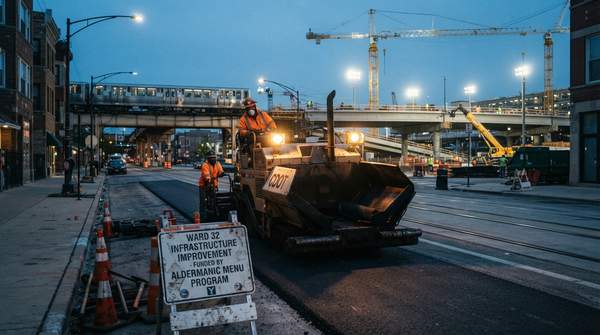
Chicago plans major infrastructure through two largely separate channels: a five-year, city-wide Capital Improvement Program (CIP) covering large projects such as roads, bridges, and municipal facilities, and the ward-level Aldermanic Menu, which hands each of the city's 50 aldermen a fixed pot of money to choose local improvements like sidewalk repairs and alley lighting. A December 2020 audit by the City of Chicago Office of Inspector General, under Inspector General Joseph M. Ferguson, found that the city-wide track lacks systematic needs-based evaluation, transparent prioritization criteria, and documented public input—a fragmentation that civic watchdogs argue undermines coherent planning.
Understanding Chicago's Capital Infrastructure Planning
Chicago's capital spending is not governed by a single unified plan. The City of Chicago released its FY2021–FY2025 Capital Improvement Program in October 2021, and, as the Civic Federation explains, the purpose of a CIP is to establish priorities that balance capital needs with available resources, pair projects with funding sources, ensure orderly repair and maintenance of capital assets, and estimate the size and timing of future debt issuance. The first year of a CIP serves as the capital budget for that fiscal year, and capital projects are costly and paid for over the years the funds are borrowed.
But a substantial share of infrastructure spending flows outside that central document. The Civic Federation notes that hyper-local projects are not part of a central capital budget: the Aldermanic Menu allocates money annually to each ward, and tax increment financing districts divert a share of property taxes for economic development within specific areas. The result is a planning landscape in which a street resurfacing project and a bridge rehabilitation may be selected through entirely different processes, by different decision-makers, under different rules.