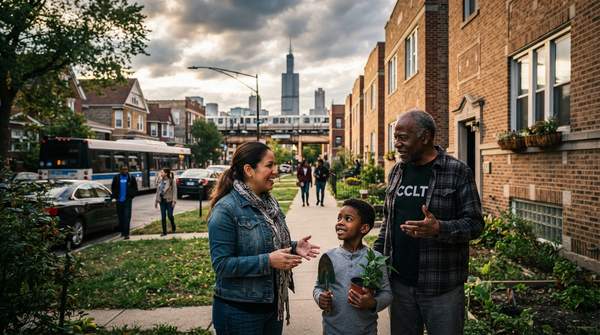
Community Land Trusts (CLTs) tackle affordable housing with an unusual legal move: they split ownership of the home from ownership of the land beneath it. A nonprofit trust holds the land permanently while a household buys the building at a price it can afford, and the two are linked by a long-term lease that limits how much the home can resell for. In Chicago, that model is operating on two distinct tracks: a citywide, municipally backed trust and a neighborhood-rooted community organization, each suited to a different scale of the city's affordability problem.
Community Land Trusts in Chicago: Diverse Approaches to Local Needs
The mechanics: separating land from home
The core of the CLT model is the ownership split. The trust itself—a nonprofit, and in some cases a quasi-governmental entity—owns the land. The family or individual purchaser owns the house or condominium sitting on it. Because the buyer never has to purchase the land, the upfront price of the home drops to a level within reach of buyers who would be priced out of the conventional market.
The two ownership interests are bound together by a long-term ground lease, typically running for decades and renewable. The lease gives the homeowner the practical benefits of ownership—stable housing costs, the ability to put down roots, and a share of any appreciation—while the trust retains stewardship of the land on behalf of the community. The City of Chicago describes its own Housing Trust as "a partner in the ownership process," giving homeowners "access to many of the benefits of traditional ownership, along with a network of support to help ensure their ongoing success."
Affordability is preserved across generations through a resale formula written into the lease. When a CLT homeowner sells, the price is capped rather than set by the open market. The seller earns a fair, predetermined return on their investment, but the home passes to the next income-qualified buyer at a below-market price. This is the mechanism that turns a one-time subsidy into a durable asset: the affordability travels with the home from owner to owner, rather than expiring the first time it changes hands.
The citywide model: the Chicago Community Land Trust
Chicago's municipal entry into this field dates to 2006, when the City of Chicago established the Chicago Community Land Trust (CCLT) as a tool to preserve the long-term affordability of homes created through city programs. According to the Metropolitan Planning Council, which documented the program in a case study, Chicago is the largest city in the United States to establish a municipal, citywide community land trust. The CCLT provides long-term affordability protection for affordable units created through city programs; by 2009 it had closed on affordable units in a building at 4150 N. Kenmore.
The trust, which the city presents to buyers as the Chicago Housing Trust, provides working individuals and families with opportunities to purchase homes at prices they can afford. Its structure reflects the scale of the challenge it was built for: a case-study analysis notes that its design is suited to Chicago's large size and its high number of condominium units, and that its deed covenant mechanism is designed to preserve affordability across a citywide scope.
The neighborhood model: Here to Stay
Here to Stay Community Land Trust represents the other approach. It is a community-based organization rather than a municipal program, and its mission is tightly geographic: creating permanently affordable homes in Chicago's Avondale, Hermosa, Humboldt Park and Logan Square neighborhoods "for generations." The organization states that it retains low- to moderate-income households across those neighborhoods through affordable homeownership and communal ownership of the land.
That neighborhood focus is a deliberate strategy rather than a limitation. The four neighborhoods it serves sit in a corridor of Chicago where rising costs have historically displaced long-term residents, and a community-based trust can concentrate its acquisitions, partnerships and organizing where displacement pressure is most acute. Where the municipal trust operates wherever city programs create affordable units, Here to Stay works from the ground up within a defined footprint.
Comparing Chicago's Community Land Trusts
The two organizations illustrate that the CLT model is not monolithic. The table below compares them across their origins and geographic focus, drawing on the city's own program materials, the Metropolitan Planning Council's case study, and Here to Stay's stated mission.
| Dimension | Chicago Community Land Trust (CCLT) | Here to Stay Community Land Trust |
|---|---|---|
| Origin / Backing | Established by the City of Chicago in 2006; operates with a quasi-governmental structure to preserve affordability of homes created through city programs | Community-based organization, not a municipal program |
| Geographic Focus | Citywide scope; structure suited to Chicago's large size and high number of condo units | Avondale, Hermosa, Humboldt Park and Logan Square neighborhoods |
| Affordability Tool | Deed covenant mechanism designed to preserve affordability in Chicago | Communal ownership of the land combined with affordable homeownership |
Read side by side, the comparison shows a genuine trade-off in scale and accountability. The municipal trust brings the resources and regulatory reach of city government and can protect affordable units wherever city programs produce them, but it depends on those programs for its pipeline. Here to Stay is accountable to specific neighborhoods and can target displacement directly, but its reach is bounded by the communities it serves. Neither approach is inherently superior; they answer different versions of the same question about who gets to stay in a changing city.
Interest in the model extends beyond the organizations themselves. State-level attention to community land trusts in Illinois has grown in recent years, with policy discussion focused on how the model can address the state's affordable housing challenges. Readers should note that this article does not detail the specific findings or recommendations of any state task force report, nor is it an exhaustive list of CLTs operating in Illinois or the Chicago metropolitan area.
Navigating Affordable Housing Options in Chicago
For Chicago households weighing their options, the practical takeaway is to consider Community Land Trusts as a viable pathway to long-term affordable homeownership in Chicago, recognizing the distinct approaches of city-backed and community-led initiatives. The citywide trust may suit buyers seeking below-market homes wherever city programs create them, while Here to Stay concentrates permanently affordable homes in four northwest-side neighborhoods. Neither path is legal or financial advice, and this article does not cover application processes or eligibility requirements for any specific program.
The clearest way to track whether the model is delivering is to watch the continued growth in the number of CLT homes available in Chicago or new policy initiatives from the Illinois Community Land Trust Task Force. Here to Stay also holds public information sessions—its website listed one for Monday, October 19th, 7:00–8:00pm—which offer a direct, observable window into how the model works in practice before any commitment is made.
Sources
- Chicago Community Land Trust (CCLT) > Metropolitan Planning Council
- Home — Here to Stay Community Land Trust
- Chicago Housing Trust