Chicago residents who want to fix a neighborhood problem have two main entry points into city government: their ward's Alderperson and the city's 311 service system. The practical rule of thumb, drawn from how ward offices and the city itself describe these channels, is that 311 is built for specific, trackable service requests — a missed garbage pickup, a rat sighting, a pothole — while an Alderperson's office is the right destination for broader policy, planning and community-wide concerns such as zoning decisions, local budget priorities and neighborhood safety strategies. Knowing which door to knock on first saves time and gets the request into the right workflow.
Alderperson vs. 311: Choosing the Right Channel
Chicago is divided into 50 wards, each represented by an elected Alderperson whose office serves as a local outpost of city government. Ward offices field resident questions, track neighborhood problems and advocate for their communities on citywide decisions. The 28th Ward office, for example, describes the alderman's role as covering local budgets, infrastructure, safety and zoning — the kinds of issues that involve choices and priorities rather than a single repair ticket.
The CHI 311 system, run by the City of Chicago, is a different tool. As the city's own 311 page explains, residents can use the CHI 311 website and mobile app to create new service requests, check the status of existing requests and see estimated resolution times, attach a photo to improve accuracy, map the request to pinpoint a location, and create an account to track their requests. That tracking and accountability structure is what makes 311 the right channel for concrete, one-off fixes.
The clearest statement of the dividing line comes from ward offices themselves. The 44th Ward's contact page, maintained by Alderman Bennett Lawson's office, tells residents to submit a 311 request for actions related to garbage and recycling, trees, streets, rats, water and flooding, building violations, and graffiti removal. In other words, the ward office itself routes routine service work to 311 rather than handling it internally — a strong signal that residents should start there too.
Decision Framework: Alderperson vs. 311
The table below categorizes common resident concerns and maps each to the most effective first point of contact, based on the functions that official city and ward sources explicitly describe for each channel. If your issue appears in the 311 column, submit it through 311 first; if it involves a decision, a priority or a community-wide question, bring it to your Alderperson's office.
| Concern | Recommended first channel | Why, based on official guidance |
|---|---|---|
| Garbage and recycling collection problems | 311 | The 44th Ward lists garbage and recycling among 311 service requests. |
| Tree trimming or removal | 311 | Tree-related actions are listed as 311 requests by the ward office. |
| Street problems such as potholes | 311 | Street-related actions are routed to 311; the city's system lets you map and photograph the location. |
| Rat abatement | 311 | Rats are explicitly named as a 311 request category. |
| Water or flooding issues | 311 | Water and flooding appear on the ward's 311 request list. |
| Building violations | 311 | Building violations are listed among 311-appropriate requests. |
| Graffiti removal | 311 | Graffiti removal is named as a 311 service request. |
| Zoning changes and proposed developments | Alderperson's office | Ward offices describe zoning and development decisions as aldermanic topics; the 44th Ward invites inquiries about proposed developments. |
| City budget and infrastructure priorities | Alderperson's office | The 28th Ward identifies local budgets and infrastructure as core alderman responsibilities. |
| Neighborhood safety strategy | Alderperson's office | Safety strategy is described by ward offices as an alderman-level concern rather than a service ticket. |
A useful habit: even when 311 is the right channel, your Alderperson's office can follow up if a request stalls. Because 311 lets you check status and resolution time, you have a concrete record to bring to the ward office if the problem persists.
Contacting Your Alderperson's Office: What to Expect
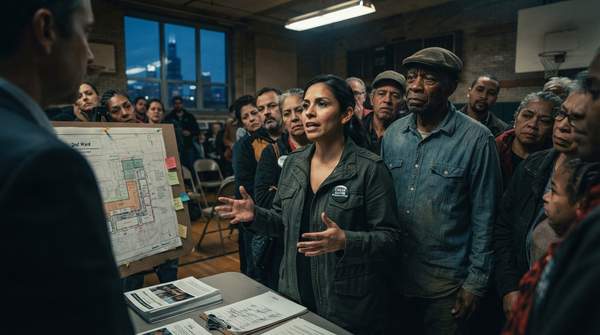
Ward offices typically offer three main avenues. Phone is best for time-sensitive or simple questions, and ward websites publish office numbers alongside their hours — the 44th Ward, for instance, lists its hours and holiday closures on its contact page. Email or a website inquiry form works well for detailed concerns, because you can lay out the issue, the location and any supporting details in writing, and the office keeps a record. Community meetings are the third avenue: ward offices hold regular meetings where residents can raise issues publicly and hear from neighbors facing the same problems.
Whichever method you choose, be specific. Include the address or intersection, dates, what you have already tried, and what outcome you are seeking. For a 311-routed issue, include the service request number if you have one. For a policy or zoning question, say plainly whether you are asking for information, expressing a position, or requesting action.
Two caveats apply across all 50 wards. This guide is for City of Chicago residents, and it deliberately does not list every ward's contact details — the City of Chicago's official ward directory is the authoritative place to find your Alderperson's address, phone number and website. Procedures and response times also vary from ward office to ward office, so treat the advice here as a general framework rather than a guarantee. And because zoning and municipal matters can carry legal weight, this is general guidance, not legal advice.
Your Next Step: Engaging with Your Chicago Alderperson
Residents should use the framework above to identify the appropriate channel — Alderperson or 311 — and the right contact method (phone, email or meeting) for their specific neighborhood concern. The measurable indicator of success is straightforward: either a successful service request submission through the CHI 311 system, with a trackable request you can monitor for status and resolution time, or a confirmed communication with your Alderperson's office regarding a policy or community issue. If your 311 request goes unresolved or your concern is bigger than a single ticket, that confirmed contact with the ward office becomes the foundation for follow-up — and, for community-wide matters, for raising it at the next ward meeting.
Sources
- 311 City Services — Chicago
- Contact — Alderman Bennett Lawson - 44th Ward Chicago