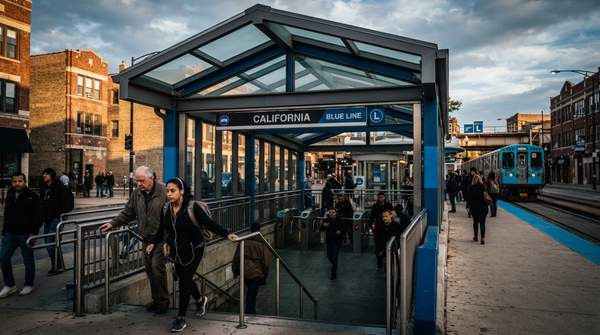
The Chicago Transit Authority is set to give one of the Blue Line's oldest stations its most significant upgrade in decades. In November 2026, the Chicago Transit Board approved a construction contract to modernize the California Blue Line station in Logan Square, adding elevators and a fully accessible entrance so riders with mobility devices can use the station independently. Construction is scheduled to begin in the fourth quarter of 2027, and the station will stay open throughout the work, with a temporary entrance and stationhouse built on adjacent St. George's Court.
California Blue Line Station: A Modernization Overview
The California station is not just old—it is one of the oldest stations on the entire Blue Line, serving the Logan Square neighborhood since its construction in 1895, according to JLK Architects, the firm providing transportation and historic preservation design services to the CTA for the project. That age is the core of the problem: like many legacy elevated stations, California was built long before accessibility standards existed, leaving riders who use wheelchairs or other mobility devices without a way to reach its platforms.
The CTA frames the project as a milestone in its All Stations Accessibility Program (ASAP), the agency's commitment to making the entire system 100% accessible to riders with disabilities. The board's contract approval in November 2026 cleared the final administrative hurdle before work can begin, with construction set to start in late 2027. The CTA notes the full value of the contract will not exceed $39.9 million, financed through the Illinois Department of Transportation and City of Chicago Tax Increment Financing funds.
Key Accessibility and Modernization Upgrades
The centerpiece of the project is vertical access. JLK Architects' project description details two new elevators, along with modifications to the existing egress stairs and additional egress capacity. Supporting that work, the design includes new structure to carry a wider elevator platform, modifications to the station's historic steel platform canopies, and a new electrical room.
At street level, riders can expect a modern, accessible entrance. Reporting on the contract awards by Mass Transit, which covered the CTA's announcement, describes the finished station as hosting upgraded elevators, stairs, accessible doors, and wayfinding. The CTA's own announcement emphasizes that the new elevators and entrance will ensure access for those who use mobility devices. Because the upgrades serve both the inbound and outbound platforms, the station will function as a fully independent travel point rather than a partial improvement.
California Blue Line Modernization: A Project Timeline
Sequencing the documented milestones shows where the California project sits in its lifecycle: a 19th-century station, a systemwide accessibility plan launched in 2018, a contract approved in late 2026, and shovels in the ground expected in late 2027.
| Date/Period | Milestone | Details |
|---|---|---|
| 1895 | Original station constructed | The California Elevated Station begins serving the Logan Square neighborhood; it is one of the oldest stations along the Blue Line. |
| 2018 | CTA launches ASAP | The All Stations Accessibility Program outlines short- and long-term station accessibility plans, with the goal of making every station accessible by 2038. |
| November 2026 | Contract approved | The Chicago Transit Board approves the construction contract, valued at no more than $39.9 million, funded by IDOT and City of Chicago TIF funds. |
| Q4 2027 | Construction begins | Work starts on elevators, the accessible entrance, stairs, doors, and wayfinding; the station remains open throughout. |
| By 2038 | Systemwide accessibility target | ASAP aims to make the entire CTA system 100% accessible to riders with disabilities. |
The timeline makes clear that the November 2026 approval is a starting gun, not a finish line: riders have roughly a year before construction activity begins, and the station's transformation will unfold over the construction period that follows.
Navigating Construction: Keeping the Station Operational
The most pressing question for daily riders is whether they will lose their station during the work. They will not. According to the CTA, the California station will remain open to commuters during construction, with crews building a temporary entrance and stationhouse on adjacent St. George's Court.
That approach means the disruption is concentrated at the point of entry rather than in service itself. Riders will adjust where they enter and exit the station, but trains will continue to serve California's platforms throughout the project. The temporary stationhouse arrangement also signals the limits of what is known at this stage: the CTA has not yet published detailed phasing for how the temporary facility will operate once work begins in late 2027, and the plans announced in late 2026 may be refined as construction approaches.
The California Project in CTA's Broader Accessibility Vision
California is one piece of a much larger program. The CTA launched the All Stations Accessibility Program in 2018 as a comprehensive plan to make all of its rail stations vertically accessible to riders with disabilities by 2038, including station concepts, cost estimates, and phasing. On the Blue Line specifically, the program's status shows uneven progress: the Racine station is complete and vertically accessible with elevator access, Pulaski is designed and funded for construction, Cicero and Austin are funded for planning, and Western, Kedzie, and Harlem are not funded at this time.
Against that backdrop, the California contract represents one of the program's funded, shovel-ready advances. As CTA President Dorval R. Carter Jr. was quoted in the agency's announcement coverage, "An accessible CTA gives more people the freedom to travel independently and connects them to everything our region has to offer." For riders with disabilities in Logan Square, the practical meaning is concrete: a station that has been off-limits to wheelchair users since 1895 will, once the project is complete, offer the same independent access the rest of the modernized system aims to provide.
What This Means for Commuters: Anticipating the New California Station
Commuters should anticipate continued service at the California Blue Line station during construction, using a temporary entrance, and look forward to significant accessibility and modernization upgrades by the project's completion. The two markers to watch are the start of construction in Q4 2027 and the establishment of the temporary stationhouse on St. George's Court—both observable events that will confirm the project is moving from approved plans to a rebuilt station.