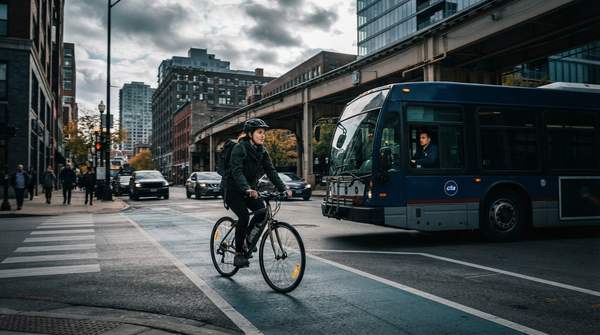
The single most important thing to know about biking and driving in Chicago is this: under Illinois law, a bicycle is treated like a vehicle. The Illinois Secretary of State's cycling manual states plainly that bicyclists must obey the same traffic safety laws that govern drivers of vehicles. That one principle drives almost everything else — who yields at an intersection, how cyclists position themselves on the road, and why failure to yield is the city's most preventable crash cause.
Understanding Chicago's Road Safety Challenge
Chicago's bike-crash problem is concentrated in one behavior. An analysis of City of Chicago crash records covering 2022 through 2025 by the law firm Briskman Briskman & Greenberg found that "Failing to Yield Right-of-Way" was the leading cause of bicycle crashes, accounting for 2,165 incidents — 25.81% of all crashes — and linked to 1,777 injuries over the four-year period. That means the top crash cause in the city is not speeding or poor lighting; it is a right-of-way mistake at an intersection or crossing.
Because cyclists and drivers share the same legal framework, preventing those crashes is a two-sided job. The same rules that require a driver to yield on a left turn also require a cyclist to ride with traffic and obey signals. The Illinois Secretary of State's manual puts the stakes bluntly: if involved in a vehicle collision, no amount of bicycle safety equipment can adequately protect a rider from the dangerous force of a car or truck. Preparation and rule-following, not equipment alone, are the defense.
Key Right-of-Way Laws for Drivers and Cyclists
Illinois law spells out duties for both sides. For drivers, the clearest high-risk case is the left turn: a driver turning left must yield to oncoming cyclists traveling straight through an intersection, per the right-of-way analysis of Chicago law. For cyclists, 625 ILCS 5/11-1505 requires a rider traveling below the normal speed of traffic to ride as close as practicable and safe to the right-hand curb or edge of the road, and bicyclists must generally ride in the same direction as traffic.
One notable exception: if a police officer directs traffic otherwise, the right-of-way laws do not apply, and riders and pedestrians must obey the officer's directions, as the Secretary of State's manual notes. The table below juxtaposes each party's legal duties in the scenarios where right-of-way conflicts most often turn into crashes.
Driver and Cyclist Responsibilities in Common Scenarios
| Traffic Scenario | Driver's Legal Responsibility | Cyclist's Legal Responsibility |
|---|---|---|
| General road use | Treat bicycles as vehicles and follow all traffic laws; bicyclists hold the same rights and duties as vehicle drivers. | Obey all traffic laws — signals, signs, and right-of-way rules — same as vehicle drivers. |
| Uncontrolled intersection (no signals or signs) | Yield to any vehicle, including a bicycle, that has already entered the intersection from a different highway when both approach at roughly the same time. | Rider on the left yields to vehicles (including other bicycles) approaching from the right when both arrive at about the same time. |
| Left turn across oncoming traffic | Yield to oncoming cyclists traveling straight through the intersection. | Traveling straight with traffic; same-direction riding and right-edge positioning apply as under 625 ILCS 5/11-1505. |
| Emerging from an alley, driveway, or building | Yield to pedestrians on the sidewalk and to vehicles on the roadway. | Yield to pedestrians on the sidewalk and to vehicles on the roadway. |
| Pedestrian crossings | Stop for people walking when the law requires, such as at crosswalks and intersections. | Stop for people walking when the law requires, such as at crosswalks and intersections. |
The pattern in the table is the article's central finding: almost every high-risk scenario is symmetrical. Whether the person emerging from a driveway is on a bike or behind a wheel, the duty to yield to sidewalk pedestrians and roadway traffic is the same — a point Divvy, Chicago's bike-share system, makes explicit for its riders. Right-of-way is not a privilege granted to whichever mode is bigger; it is a shared legal duty.
Navigating Chicago's Bike Lanes
Chicago riders will encounter two basic on-street designs, defined in the Illinois Secretary of State's cycling manual. Striped bike lanes are on-street lanes marked with a bicycle symbol and an arrow. Marked shared lanes are not striped but display the bicycle symbol plus a chevron, indicating that bikes and cars share the space.
Positioning within a lane matters as much as recognizing its type. The Chicago Department of Transportation advises that bicyclists should usually ride in the middle of a bike lane — but in a lane next to a line of parked cars, riders should shift to the left side of the lane so an opening car door cannot hit them. The state manual echoes the warning: riders should stay within a properly marked bike lane when practical, stay alert to parked vehicles, and avoid riding in the "door zone" where a door can swing into the lane.
Not every street gets a lane, and that is deliberate. CDOT explains that bike lanes make the average person feel safer about biking and cut down on weaving, but not all streets are wide enough. Facility selection depends on street condition, bicycle usage volumes, speeds and routes, and automobile volumes and speeds where present. Drivers should treat both markings the same way: the stripe or chevron tells you where bikes belong, and the same right-of-way laws from the table above still govern every interaction.
Essential Safety Practices for Cyclists
Beyond right-of-way, Illinois rules impose several practical duties on riders, which Divvy summarizes for Chicago cyclists. Ride with traffic — people biking are required by law to ride in the same direction as cars, and where there is no usable bike lane, ride as far to the right as possible while staying at least 3–4 feet from the curb or parked cars. Obey all traffic lights and signs, since the same laws apply to bicycles as to motor vehicles in Illinois.
Signal your intentions. Hand signals let drivers and other cyclists know where you're going: for a left turn, stick your left arm straight out; for a right turn, extend your right arm straight out, or raise your left arm bent upward at the elbow. Divvy also encourages riders to leave sidewalks for pedestrian traffic and walk bikes there, to use a bell to alert others when you have the light, and to stop for people walking wherever the law requires it — including at crosswalks and intersections. A well-fitted helmet, worn level and buckled, is encouraged, though the state manual is clear that no equipment substitutes for following the rules.
Fostering a Culture of Shared Road Safety
Chicago's crash data gives both road users a concrete priority. With failure to yield causing more than a quarter of the city's bicycle crashes and nearly 1,800 injuries in four years, the highest-value change any individual can make is intersection discipline: drivers checking for oncoming cyclists before turning left, and cyclists riding with traffic, signaling turns, and yielding where the law requires it.
This guide covers Illinois law as it applies in Chicago; it is informational and not a substitute for legal advice, and it does not address e-bike-specific regulations or map every bike lane in the city. The decision it points to is simple: both drivers and cyclists in Chicago must actively apply their legal responsibilities — the yield rules in the table above — to prevent the city's most common crash type. The measurable outcome to watch is a decrease in "failure to yield" bicycle crashes reported in future City of Chicago traffic data. Until that number moves, every intersection remains where the city's bike safety problem lives.