The Chicago Transit Authority pursues cultural partnerships on three distinct fronts: large-scale event collaborations that drive ridership, community "placekeeping" projects that turn transit spaces into neighborhood hubs, and artist activations that bring performances and public art directly into stations. Together, these efforts reflect a deliberate strategy of using culture to make transit more than a way to get somewhere — making it a place worth being.
Introduction: CTA's Vision for Cultural Engagement
The CTA's own planning documents frame these partnerships as part of its core mission rather than as decoration. Its budget book describes marketing efforts focused on "driving ridership, partnering with anchor institutions and strategic events, and communicating major network improvements to the public." Culture, in this framing, is a rider-engagement tool as much as a community service.
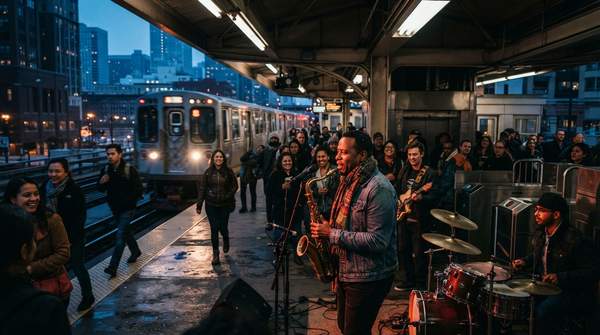
The clearest expression of the cultural side of that strategy is "Elevating Culture Through Transit," a partnership between the CTA, Elevated Chicago and community-based cultural organizations. According to the CTA, the initiative brings performances, public art and creative programming directly into transit environments, creating opportunities for artists and performers to engage riders, celebrate neighborhood culture and "transform everyday transit experiences into moments of connection and discovery."
When the CTA announced an expanded round of this work, Acting President Nora Leerhsen described the underlying philosophy: "When we invest in art and culture along our corridors, we're doing more than beautifying stations — we're signaling to residents that their histories, their stories, and their presence matter."
Comparing CTA's Cultural Partnership Strategies
The three partnership types differ in scale, goal and what riders actually experience. The table below categorizes the documented initiatives along those dimensions.
| Partnership Type | Primary Goal | Example(s) | How it Affects Riders |
|---|---|---|---|
| Major event collaborations | Drive ridership by partnering with anchor institutions and strategic events | Partnerships named in the CTA's budget book, including Lollapalooza and the Chicago Fire soccer club | Transit positioned as the practical way to reach big occasions |
| Community placekeeping projects | Transform utilitarian transit spaces into community hubs; support equitable transit-oriented development | "Elevating Culture Near Transit" grants, including the Endeleo Institute's 95th Street ETOD Placekeeping Project | Stations and corridors become welcoming, culturally rich spaces tied to neighborhood identity |
| Individual artist and performer activations | Engage riders with live performance and public art in stations | "Elevating Culture Through Transit" activations at CTA stations and surrounding public spaces | Everyday commutes become moments of connection and discovery |
The distinction matters because each type serves a different strategic purpose: event partnerships are fundamentally about ridership and logistics, placekeeping is about neighborhood development, and artist activations are about the ambient experience of riding.
Major Event Collaborations: Boosting Ridership for Big Occasions
The event side of the strategy is documented in the CTA's budget book, which states that marketing efforts in the past year focused on driving ridership by "partnering with anchor institutions and strategic events." The examples the agency cites are Lollapalooza, the major annual music festival, and the Chicago Fire soccer club.
These partnerships work differently from the cultural initiatives. Rather than changing what a station feels like, they position transit as the practical access route for large gatherings, aligning the agency's marketing with events that generate concentrated travel demand. The budget book treats them as one component of a broader promotional effort that also includes communicating network improvements to the public.
Community Placekeeping: Transforming Transit Hubs into Cultural Centers
The most developed cultural strand is "placekeeping," a term that signals preservation of existing neighborhood identity rather than the more familiar "placemaking." Elevated Chicago, the CTA's lead partner here, describes its Arts & Culture Strategy as a community-driven initiative to protect and perpetuate Chicago's diverse cultural identities as part of equitable transit-oriented development, aiming to "center culture as infrastructure" and prevent displacement.
ETOD itself is a planning approach the CTA defines as promoting walkable, mixed-use development near train stations and major bus lines, prioritizing investment in disinvested communities. The CTA and the city's Department of Planning and Development applied this approach in the 95th Street Corridor Plan, covering a two-mile stretch between Halsted Street and Cottage Grove Avenue.
Through the "Elevating Culture Near Transit" initiative — a partnership with Elevated Chicago and the MacArthur Foundation — three community organizations received grants to bring performance and cultural activations to stations and transit corridors. One grantee, the Endeleo Institute, is running the 95th Street ETOD Placekeeping Project, which will work with community partners, artists, residents and local youth to document the histories of neighborhoods along 95th Street, including Lilydale and West Chesterfield. Those stories will become murals, signage, visual illustrations and digital content, culminating in a large cultural event along the corridor. The project builds on a 2024 pilot through the Regional Transit Authority's Transit Station Activations project.
As the CTA's announcement put it, these placekeeping projects aim to transform utilitarian, "pass-through" transit spaces into vibrant community hubs and destinations, setting the stage for deeper neighborhood investment.
Conclusion: A Connected City Through Culture
Taken together, the three partnership types show an agency that treats culture as operational infrastructure. Event collaborations serve ridership goals, placekeeping projects embed the CTA in neighborhood development, and artist activations change the daily experience of commuting. The unifying thread is the CTA's stated ambition, noted in its budget materials, to take a more active role in development and activation around its transit hubs.
Engaging with CTA's Cultural Initiatives
Local artists and community organizations can actively participate in CTA's cultural activation programs by responding to calls for proposals. The CTA has issued open calls for "transit loving artists and entertainers" to participate in station activations, and grant-funded opportunities like the "Elevating Culture Near Transit" initiative have channeled support to community organizations through Elevated Chicago and the MacArthur Foundation.
To act on this, monitor the CTA's official art and public-art webpages and its social media channels for new program announcements and application deadlines. The measurable indicator of success is straightforward: a submitted proposal in response to a posted call, or a community organization's application to the next round of placekeeping grants when announced.